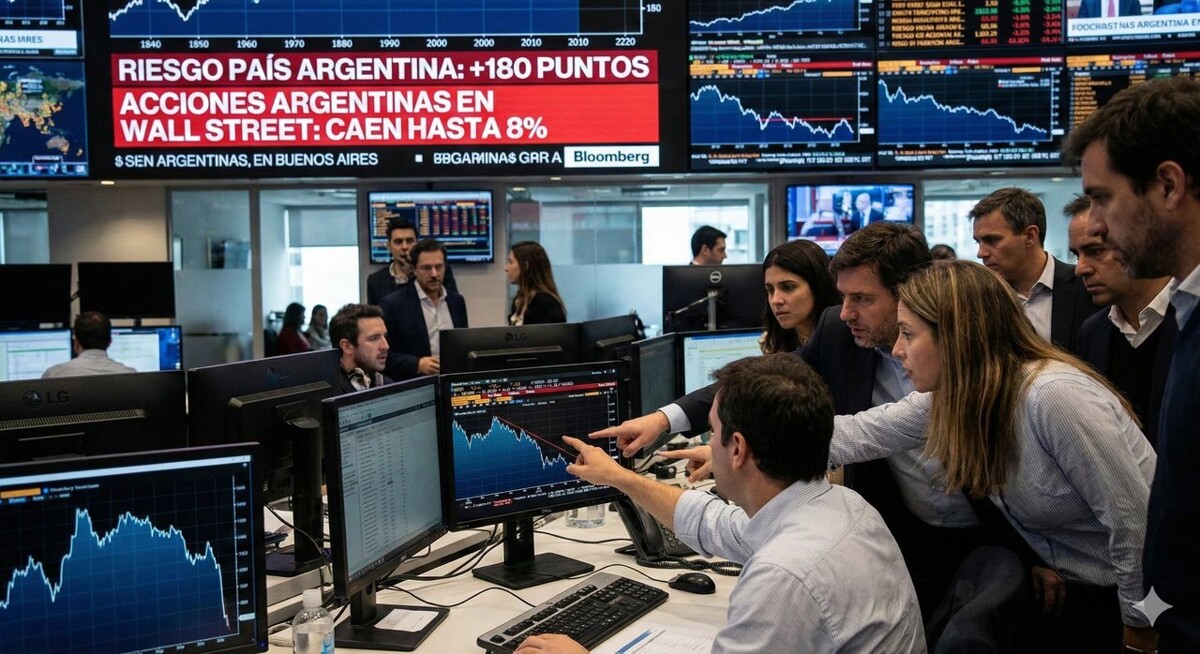
Argentine assets had a forgettable day this Thursday, with widespread declines in New York-listed stocks and a new rise in country risk. There was a growing aversion to risk amid increasing local political tensions. According to Noticias Argentinas agency, Argentine company papers on Wall Street (ADRs) recorded drops of up to 8%, led by Bioceres, followed by banks Grupo Supervielle (-7.4%) and BBVA (-7.1%). On the local stock exchange, the S&P Merval index fell 2.9% in pesos. The market's sour mood also hit sovereign debt. Dollar-denominated bonds extended their negative streak: Globales fell by up to 0.8% (with the GD46 leading the way) and Bonares rose by up to 1.4%, dragged down by the AL41. This dynamic directly impacted the country risk measured by J.P. Morgan, which posted its biggest increase in nearly three months and headed toward the 520 basis points mark, failing to break through the 500-point floor it had achieved last week. Analysts cite a combination of factors to explain the decline. This includes what is now beginning to be mentioned as the 'Lavagna factor.' Lavagna's resignation created uncertainty among investors. The official's departure was hastened by the government's decision not to update the inflation measurement base (keeping the 2004 base instead of the 2017/2018 one), a postponement that was confirmed by Minister Luis Caputo until the disinflation process is complete. This all occurs as a mission from the International Monetary Fund (IMF) is in the country for a review of targets. In this case, the plunge in Argentine assets seems linked to a contagion effect from an unstable climate in major markets. On Wall Street, New York's three leading indexes (Dow Jones, Nasdaq, and S&P500) were all down nearly 1% in the afternoon, dragged down by tech stocks and weaker-than-expected employment data from the United States. The AI Factor Even though tech company earnings meet or exceed many analysts' expectations, it was also noted that many sector companies presented forecasts that raise doubts among investors, such as a possible chip shortage for the development of artificial intelligence (AI). Meanwhile, Bitcoin fell below $70,000 for the first time since November 2024. In this context, shares of Argentine companies listed in the United States were down sharply by up to 7%, as in the case of Supervielle bank. Other entities were in the red, such as BBVA, Galicia, and Macro. The dollar, for its part, experienced another day of stability in the domestic market.